
You order a pizza. The restaurant sells it for ₹200. You pay ₹430.
Nobody stole from you. Every rupee was disclosed, itemised, and agreed to when you tapped "Place Order." And yet the number at the bottom of the bill has almost nothing to do with the number on the menu.
Most of us have stopped noticing. The gap has been there so long it feels like the price of ordering in — the way a movie ticket costs more than the film. But it isn't a law of nature. It's a stack of decisions, and once you see the stack, you can't unsee it.
Where the money actually goes
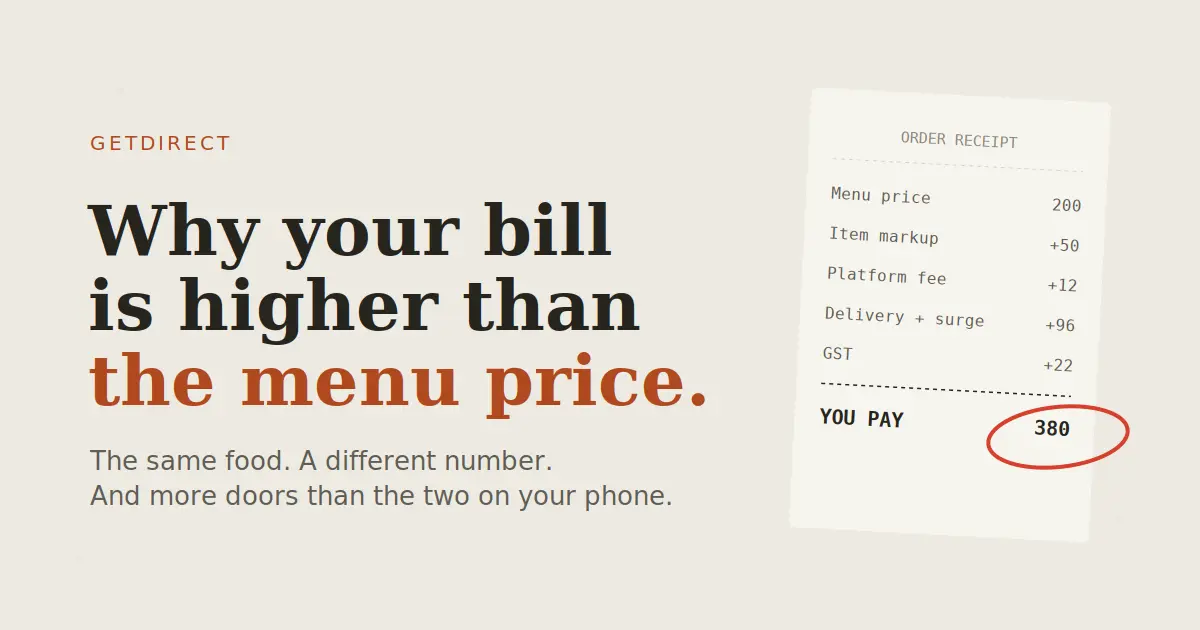
Pull up your last food delivery bill. Not the total — the breakdown. You'll usually find some version of this:
The item price itself is often inflated. This is the part people miss. Many restaurants list higher prices on delivery apps than they charge at the counter, because the app takes a commission on every order — widely reported in the range of 18–30%. The restaurant doesn't absorb that. It builds it into the menu. So before a single fee appears, you may already be paying a marked-up price for the same food.
Then the fees arrive. A platform fee. A delivery fee. A surge charge if it's raining, or a weekend, or dinner time — which is to say, whenever you actually want to order. GST on the food. Sometimes a small "handling" charge nobody can quite define.
Individually, each line looks trivial. ₹10 here. ₹35 there. Nobody cancels an order over ₹10.
That's the design.
The maths nobody does
Percentage-based markups scale with your order.
A single ₹250 meal might cost you ₹80 extra. Annoying, but survivable. A Sunday dinner for five — where you're already at ₹1,500 — carries the same percentages applied to a much larger base. Suddenly the gap isn't ₹80. It's several hundred rupees.
The orders you're least likely to scrutinise are exactly the orders where the markup costs you most. You're feeding your family, the kids are hungry, you tap through the payment screen and move on.
The part almost nobody knows
Here's the thing that changes the picture entirely.
Most people, when they try to save money on food delivery, open two apps and compare. And they find… almost nothing. The big aggregators tend to land within a few rupees of each other on the same order. You did the work and saved ₹15.
That's because you were only ever looking at two of the routes.
Your food can reach you by more paths than the two apps on your phone. Many restaurants now sell through ONDC — India's open commerce network — and many have their own direct ordering channels. These routes don't carry the same commission structure, which means the same dish, from the same kitchen, can arrive at a genuinely different price.
You can't see those routes. They're not on your home screen. Nobody advertises them to you.
That's the gap. Not Swiggy versus Zomato. The routes you don't know exist versus the two you do.
What GetDirect does
GetDirect checks all of them at once.
When you build an order, we fetch live prices across Swiggy, Zomato, ONDC, and our direct restaurant partners — and show them side by side, with fees and delivery included. Not the sticker price. The number you'd actually pay.
Then you pick. Usually, the cheapest option isn't one of the two you'd have checked yourself.
- We're free. Download and use costs you nothing.
- One account. You don't need logins for every platform.
- You order and pay inside GetDirect. No bouncing between apps.
- You see the total, not the trick. Fees included, before you commit.
Savings vary by restaurant, city, and order — we're not going to pretend otherwise. But you'll know, in about four seconds, instead of guessing.
Test it in sixty seconds
Don't take our word for it.
- Build your usual order on the app you normally use. Go all the way to the payment screen — that's where the fees finally appear.
- Screenshot the total.
- Build the same order on GetDirect.
- Compare.
If we can't beat it, don't use us. We're comfortable saying that, which should tell you something about what we expect you to find.
The point
Food delivery was supposed to make eating at home easier. It also made it substantially more expensive, quietly, one small fee at a time — and we all agreed, because each individual charge was too small to argue with.
You're not being careless with money. You're being charged in a way that's specifically designed not to be noticed, through the only two doors you were shown.
There are more doors.
[Download GetDirect — free]
GetDirect is available on Android and iOS. Prices, savings, and route availability vary by restaurant, city, and order.