
Short answer: Food delivery costs more than the restaurant's own menu price for two reasons. First, delivery apps charge restaurants a commission per order — widely reported at 18–30% — and many restaurants recover it by listing higher prices on the app than they charge at the counter. Second, the app adds its own charges on top: platform fee, delivery fee, surge pricing, and GST. Together these can push your final bill well above the actual price of the food.
There is also a third fact most people never learn: the two apps on your phone are not the only way to order your food. We'll get to that.
Is the menu price on Swiggy and Zomato the same as in the restaurant?
Often, no.
This is the most misunderstood part of food delivery pricing, because it's invisible. There's no line item called "menu inflation." The dish simply costs more than it does if you walk in.
The reason is commission. Aggregators charge restaurants a commission on every order — reported in the 18–30% range, depending on the restaurant's size and leverage. A small independent restaurant has almost none, and pays near the top.
No restaurant can absorb a cut that size on food-margin economics. So the listed price goes up to cover it. From the restaurant's side, that's survival. From yours, it means the ₹250 biryani on the app may be a ₹200 biryani wearing a commission.
How to check: look at the restaurant's own menu — in-store, or on their own site — and compare it to the app listing.
What is the platform fee on food delivery apps?
A flat charge added to every order, regardless of size or distance. It began at a few rupees and has been raised repeatedly across the Indian market. It doesn't go to the restaurant, and it doesn't go to the rider.
Why is the delivery fee higher when it's raining?
Surge pricing. Delivery fees rise during high demand — rain, weekends, late evenings, festivals.
The structural catch: those are precisely the times you most want food delivered. So the "normal" fee you see at 3pm on a Tuesday is not the fee most people actually pay.
What are all the charges on a food delivery bill?
| Charge | What it is |
|---|---|
| Item price | Often inflated to cover the app's commission |
| Platform fee | Flat fee per order, paid to the app |
| Delivery fee | Distance and demand based |
| Surge / rain fee | Applied at peak demand |
| GST | Government tax on food |
| Packaging | Sometimes charged separately |
Each line is small enough to ignore. That is why there are so many of them.
Is Swiggy or Zomato cheaper?
Usually, neither — by any amount that matters.
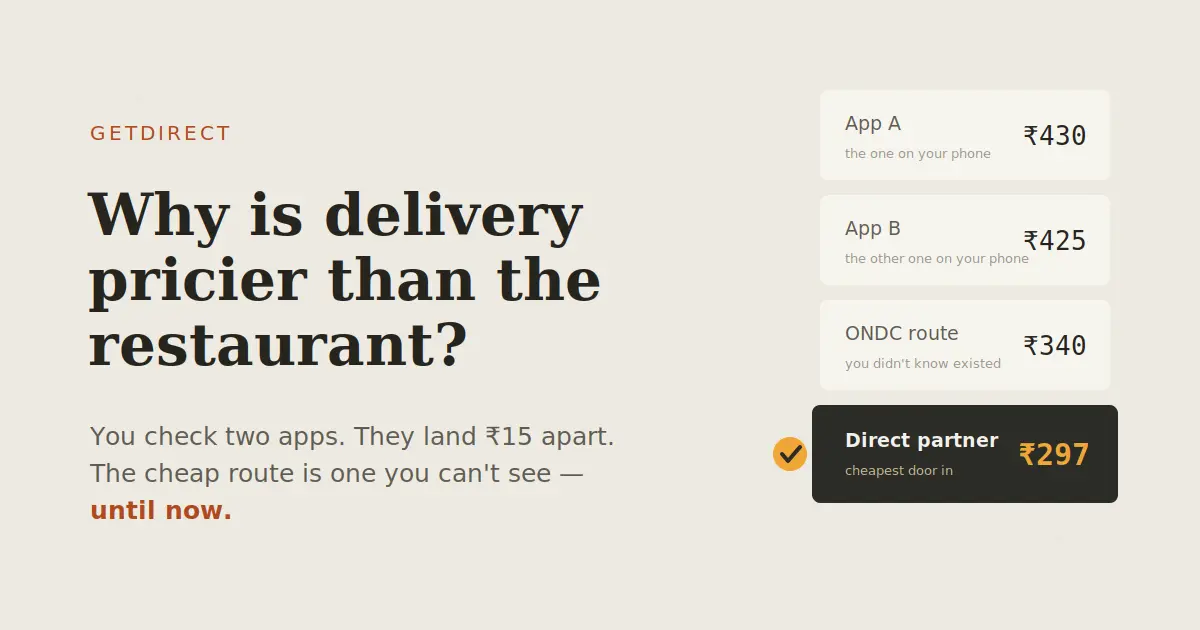
This is the discovery people make when they finally start comparing: the two big aggregators tend to land within a few rupees of each other on the same order. You open both apps, do the work, and save ₹15.
Comparing the two apps on your phone is comparing two doors into the same building.
So what's actually cheaper?
The routes you can't see.
Many restaurants in India now also sell through ONDC — the government-backed Open Network for Digital Commerce — and many have direct ordering channels of their own. These routes don't carry the same commission structure as the large aggregators, which means the same dish, from the same kitchen, can reach you at a meaningfully different price.
The problem is discovery. You don't know which restaurants near you are on which network, and there's no obvious way to check. So the cheaper route sits there, unused, while you order from the app on your home screen.
How GetDirect makes food delivery cheaper
GetDirect is a price comparison app that checks every route at once — Swiggy, Zomato, ONDC, and our direct restaurant partners — and shows you what each one would actually cost, fees included.
- Free to download and use.
- One account. No juggling logins across platforms.
- Real totals, not sticker prices. Fees and delivery included before you commit.
- Order and pay inside GetDirect. You aren't bounced to another app.
- Coupons applied automatically, so you're not hunting for codes.
Savings vary by restaurant, city, and order size. The point isn't that we guarantee a number — it's that you stop guessing.
Test it yourself — the 60-second bill check
- Build your usual order on the app you currently use. Go to the payment screen, where the fees finally appear.
- Screenshot the total.
- Build the same order on GetDirect.
- Compare the two numbers.
If we can't beat it, don't switch.
The point
You are not bad with money. Food delivery pricing is structured so no single charge is ever large enough to argue with — and you were only ever shown two of the doors.
Look at one bill properly. That's all this takes.
[Download GetDirect — free]
App Store | Play Store
GetDirect is available on Android and iOS. Savings and route availability vary by restaurant, city, and order. Commission and fee figures cited reflect publicly reported industry ranges.