
There's a small place near you. You've been going for years. The owner knows your order. The food hasn't changed since the day it opened.
And every time you order it on a delivery app, that restaurant makes less money than if you'd walked in.
Sometimes it makes almost nothing at all.
The commission
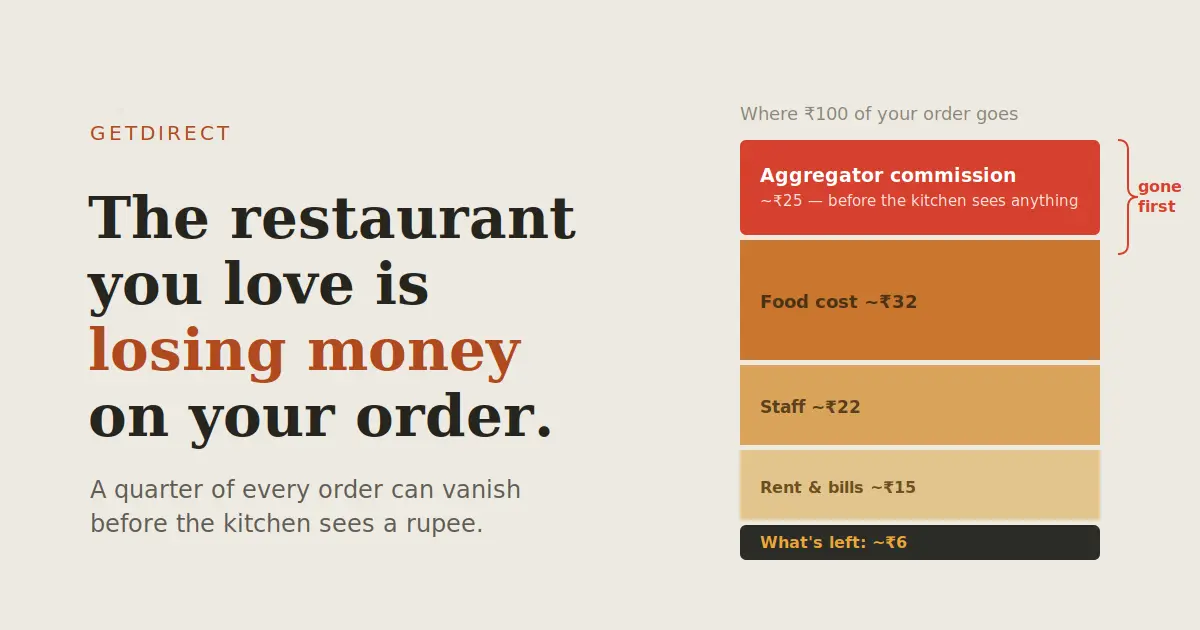
Delivery aggregators charge restaurants a commission on every order — reported across the Indian market at roughly 18–30%, depending on how much leverage the restaurant has. A large chain negotiates. A single-location family restaurant does not.
Now hold that against how restaurants actually work.
Food cost is typically 30–35% of the menu price. Staff, another 20–25%. Rent, in any decent location, 10–15%. Then electricity, gas, packaging, licences, maintenance.
A well-run independent restaurant in India operates on a net margin in the range of 5–10%. That's the good outcome. That's what success looks like.
Take a quarter off the top of that.
You don't need to finish the arithmetic. There was never enough margin to give away that much of it.
So how do they survive?
Three ways, and you've experienced all of them without knowing.
They raise the price on the app. The ₹200 dish becomes a ₹250 dish, listed only on delivery. This is why the app price and the counter price don't match. It isn't a scam — it's a restaurant trying to make the maths close.
They shrink the portion. Quietly. A little less paneer. A smaller box. Nobody announces this.
They accept discounts they can't afford. The app runs a big campaign. Participating restaurants get visibility; non-participating ones sink down the listings. So they participate, and absorb the loss, and hope the volume covers it. Often it doesn't.
None of these were choices anyone wanted to make. They're what's left after the commission.
Why they can't just leave
Because the app is where the customers are.
Once a platform becomes the front door to the market, the businesses inside it can't afford to be outside it — regardless of what it costs to stay. Delisting means invisibility. Invisibility means closure.
So restaurants stay, and the terms are what they are.
So restaurants stay, and the terms are what they are.
Owners talk about this — rarely in public, because complaining about the platform that controls your visibility isn't a smart move. But it comes up constantly, quietly, in kitchens across the country.
There's another way in — and most customers can't see it
Here's what's changed, and what almost nobody has noticed.
Restaurants are no longer stuck with one door. Many now sell through ONDC, India's open commerce network, and many have direct ordering channels of their own. These routes carry a very different cost structure. More of what you pay stays with the kitchen that cooked your food.
The catch is discovery. These routes exist, but they aren't on your home screen. You have no way of knowing that the restaurant you're about to order from on an aggregator also sells directly — usually for less.
So the cheaper, fairer route sits unused, and you order through the expensive one, and the restaurant keeps a fraction of what you spent. Not because anyone chose that. Because you couldn't see the alternative.
What GetDirect does
GetDirect shows you every route at once.
When you build an order, we check Swiggy, Zomato, ONDC, and our direct restaurant partners — live — and show you what each would actually cost, fees included. You pick.
We're not going to tell you every order on GetDirect bypasses commission. That isn't true, and you'd catch us. If the aggregator is genuinely cheapest for your order, we'll show you that, and you can take it.
But when a direct or ONDC route is available — and increasingly it is — you get a lower bill and the restaurant keeps more of it. That's not a trade-off. It's the same rupee, doing more work, because fewer people took a cut on the way.
The thing worth sitting with
Every neighbourhood restaurant that closes takes something with it that doesn't come back. Not just a business — a recipe someone's family carried, a place people met at, eleven jobs.
They aren't closing because you stopped eating their food. Many are closing while you're still ordering it, twice a week, at a price that leaves them very little.
You can keep ordering the same food, from the same kitchen — and simply check whether there's a better door in.
That's the entire ask. It takes four seconds.
[Download GetDirect — free]
GetDirect is available on Android and iOS. Route availability and savings vary by restaurant and city. Commission and margin figures reflect publicly reported industry ranges; individual restaurants vary.